
0
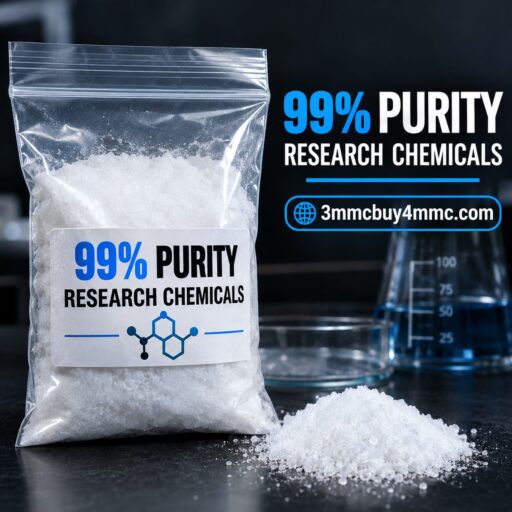
Buy 3-CMC Crystal Powder Online
Price range: €45.00 through €3,500.00
| Feature | Details |
|---|---|
| Brand | Research Chemical Grade 3-CMC |
| Composition / Ingredients | 3-Chloromethcathinone (3-CMC) |
| Form / Appearance | Crystal Powder |
| Purity | ≥99% (Analytically Verified) |
| Duration of Effects | Laboratory-observed; depends on experimental protocol |
| Indications / Usage Areas | Neuropharmacology, behavioral studies, analytical research |
| Application Method | Laboratory measurement, solution preparation |
| Shelf Life | 2–3 years |
| Storage Conditions | Cool, dry place (2–25°C), away from light |
| Package Contents | 1 x 5g / 10g / 20g depending on selection |
| Country of Origin | Netherlands |
| Licensing / Certification | EU & FDA-approved laboratory-grade production |
| Safety Notes / Side Effects | Research use only, follow lab safety protocols, avoid human consumption |
Description
Why High-Purity 3-CMC Crystal Powder Matters.
Precision is the foundational pillar of modern analytical pharmacology and forensic research. When laboratories look to Buy 3-CMC Crystal Powder (3-Chloromethcathinone hydrochloride), they require a compound that meets exact stoichiometry and crystalline uniformity. Impurities, unreacted synthesis precursors, or isomer contamination introduce noise into high-performance liquid chromatography (HPLC) runs, skew mass spectrometry (MS) fragmentation profiles, and corrupt binding kinetics.
At 3mmcbuy4mmc.com, we eliminate batch-to-batch variation by supplying exclusively lab-tested, crystalline-grade materials. By sourcing high-grade 3-CMC crystal powder, laboratory researchers ensure that experimental outcomes reflect true molecular interactions rather than chemical artifacts or solvent residues.
The Scientific Foundation: How 3-CMC Interacts at the Molecular Level
To utilize 3-CMC effectively within laboratory environments, researchers must understand its structural characteristics and pharmacodynamic profile. 3-CMC is a substituted cathinone derivative featuring a chlorine atom at the meta-position (3-position) of the phenyl ring, linked to a propan-1-one backbone with an N-methyl substitution.
Key Structural & Bio-Assay Specifications
-
Systematic Name: 1-(3-chlorophenyl)-2-(methylamino)propan-1-one monohydrochloride
-
Molecular Formula: $C_{10}H_{12}ClNO \cdot HCl$
-
Molar Mass: 234.12 g/mol
-
Form Factor: High-density, translucent crystalline matrix
-
Melting Point: Characterized sharp thermal degradation profile (201°C – 204°C)
-
Assay Target: Monoamine transporter affinity assays (DAT, NET, 5-HTT)
In bioanalytical bioassays, 3-CMC acts as a monoamine transporter substrate, releasing dopamine and noradrenaline in vitro while displaying selective serotonin reuptake inhibition depending on matrix concentration. This makes the compound an essential reference standard for comparative studies involving cathinone SAR (structure-activity relationships).
Core Experimental Advantages of Crystalline 3-CMC Matrices
Choosing a high-density crystal structure over amorphous powders offers distinct technical advantages in a laboratory setting:
-
Superior Chemical Stability: The crystalline lattice reduces the exposed surface area, significantly lowering rate constants for ambient oxidation and moisture absorption.
-
Simplified Quantitative Dispensing: High bulk density allows for precise gravimetric measurements without static dispersion issues common with fine powders.
-
High Solubility Profiles: Dissolves rapidly and completely in aqueous buffers, ethanol, and DMSO without leaving insoluble organic precipitates.
-
Clean Chromatographic Peaks: Produces sharp, well-defined retention times under reverse-phase HPLC methods without tailing effects.
Primary Research Demands: Who Requires 3-CMC Crystal Powder?
Our reference materials are formulated strictly for legitimate academic institutions, toxicological screening facilities, private analytical laboratories, and forensic research groups. Primary application areas include:
-
Forensic Toxicology: Establishing qualitative and quantitative reference libraries for biological fluid screenings (LC-MS/MS).
-
Neurochemical Research Facilities: Evaluating monoamine transporter kinetics, reuptake inhibition parameters, and receptor binding profiles.
-
Organic Analytical Chemistry: Utilizing NMR and GC-MS spectroscopy to study ring-substituted cathinone fragmentation pathways.
-
Medicinal Chemistry Studies: Analyzing substituent effects (halogenation at the 3-position vs. 4-position) on molecular stability and binding energy.
Additional information
| Quantity in grams | 5grams, 10grams, 25grams, 50 grams, 100grams, 250grams, 500grams, 1000grams |
|---|
Related products
-
1-propionyl-LSD Blotters 150mcg
Price range: €25.00 through €285.00 Select options This product has multiple variants. The options may be chosen on the product page -
Buy 2-FMA Pure Powder
Price range: €45.00 through €1,200.00 Select options This product has multiple variants. The options may be chosen on the product page -
Buy 2-MMC Pellets – 180mg
Price range: €15.00 through €550.00 Select options This product has multiple variants. The options may be chosen on the product page -
Buy 3-CMC Crystal Chunks
Price range: €45.00 through €3,100.00 Select options This product has multiple variants. The options may be chosen on the product page
Reviews
There are no reviews yet.